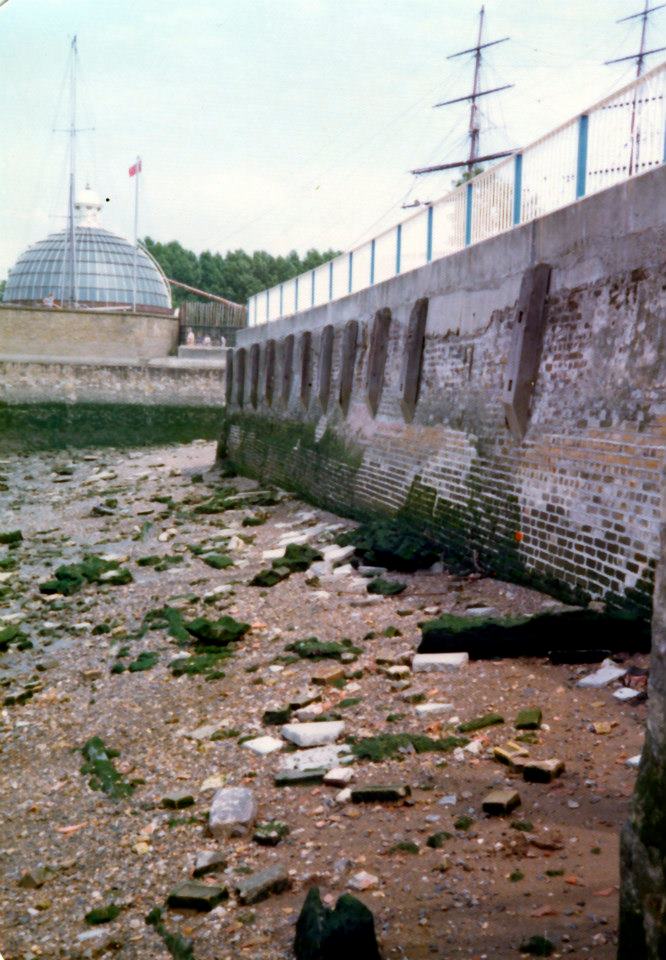
The Greenwich foreshore at low tide
The tide at Greenwich, from where global time was first measured, is never at the same time each day. A mass influx of water sends a boat there up and then down about six and a half metres every 12 hours and 25 minutes.
This is what the Thames looks like at low tide: missing.
You can tell this Is Greenwich because of the masts of the Cutty Sark, safe in its dry dock from the twice a day churning waters.
What are we here, standing on the river bed? Temporarily of course.
I saw him standing there
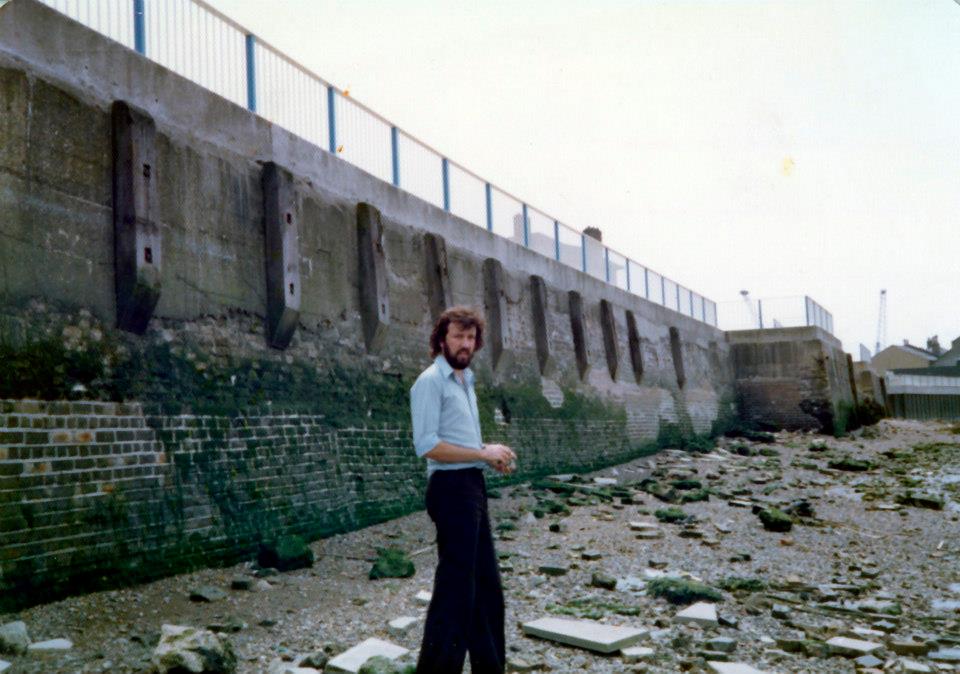
There he is, Bob Cattell, looking back at what we were looking at just now. We’re facing upstream this time. It’s 1977 or 8 – we don’t know which – but we do know who he is. He’s 29 or 30 years old and earns his living as a freelance copywriter in PR and advertising. He’s also involved in supporting charities, Friends of the Earth and The Book Trust. His friends know him as a voracious reader, an avid traveller, a generous host, a controversial conversationist and a consistent friend.
He’s also mad about cricket.
But none of that’s why he’s standing on the bed of the Thames at Greenwich. For Robert Andrew Catell – son of a timber merchant and a primary school teacher, and better known as Bob – has a dream.
Did you spot the timbers bolted to the wall? These are dockside fenders against which floating ships can collide unharmed. No surprise there, this is Greenwich. The maritime heart of London for centuries.
And here’s a boat
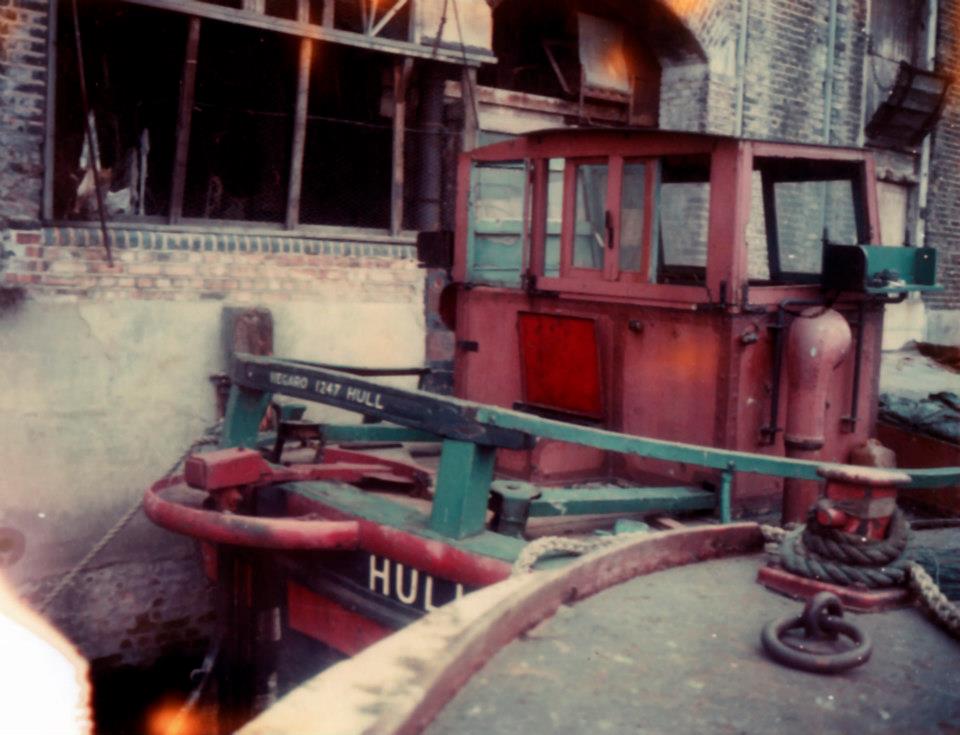
Of course there is you’ll say, this is the Thames isn’t it? So why is Hull, a major port in Yorkshire, written all over it?
We’re still in London but on the north side of the river in Rotherhithe. We don’t know exactly when nor where, but in the mid 70s Bob and his mate Chris Moore came across this beaten-up old barge, tied up and slowly decaying.
It’s a Humber keel barge, lost in London for some reason. You can see the name, Hegaro, and it’s still got its registration number from the Hull Port Authority, 1247. These barges plied the mighty Humber and the river men were a proud bunch: hard working, living on board, earning a living from the transportation of dry and wet goods on the inland waterway network. Bob thought this one carried coal, but the records show it was animal skins, for tanning by the biggest firm in the region – Hodgson’s of Beverley.
The keel appears from the Lloyds record to have been laid in 1941. Once all sailboats, by 1949 when Bob was one year old these barges had all been converted to mechanical power and built with a steel hull. By the time of this picture, Hegaro had a seized-up 3 cylinder Perkins marine diesel engine made in Peterborough in what was then Huntingdonshire. Just 22 miles to the west of Wisbech where Bob was born – and where I was to get my first acting job in 1973.
Small world.
Here’s a man and his dream
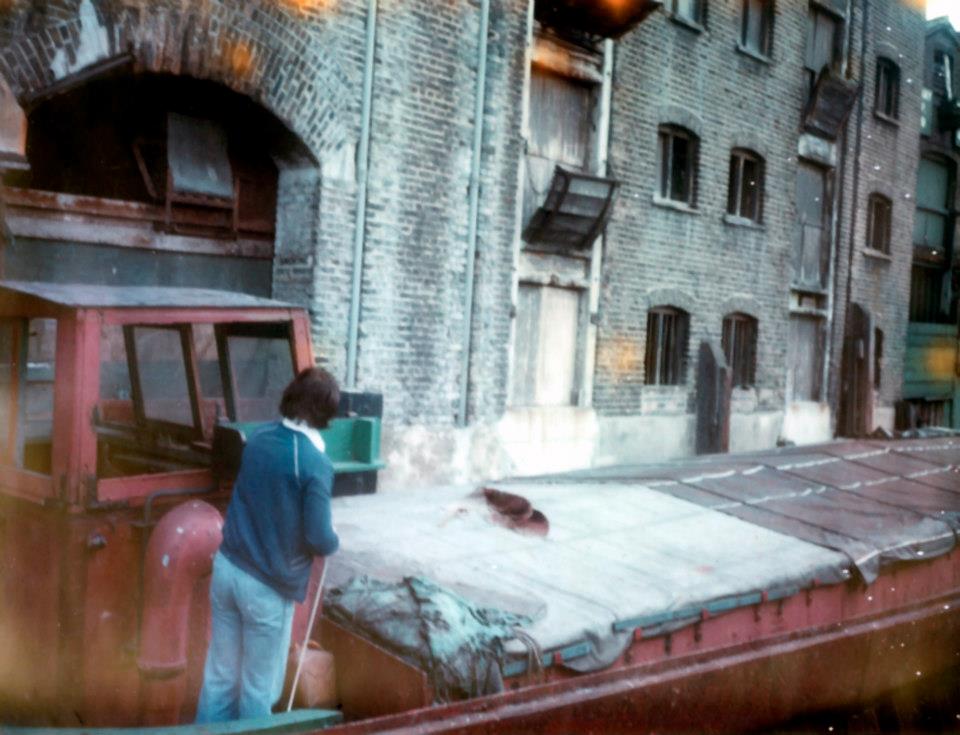
We don’t know how it happened but here’s Bob (or maybe Chris?) on his boat, the Hegaro, moored as we have seen by one of the huge warehouses in Rotherhithe.
He and Chris were to spend the next two years of weekends and evenings labouring on the conversion of this barge.
Somehow he cajoled the Port of London Authority into rent him a mooring on the Thames at Greenwich, the one we have already seen. They were reluctant, but he persuaded them to let him moor his barge alongside two of the most famous vessels in British maritime history: Gypsy Moth IV and the Cutty Sark. A PR coup from a PR professional. It was 1978.
What had he and Chris been up to for two years?
This
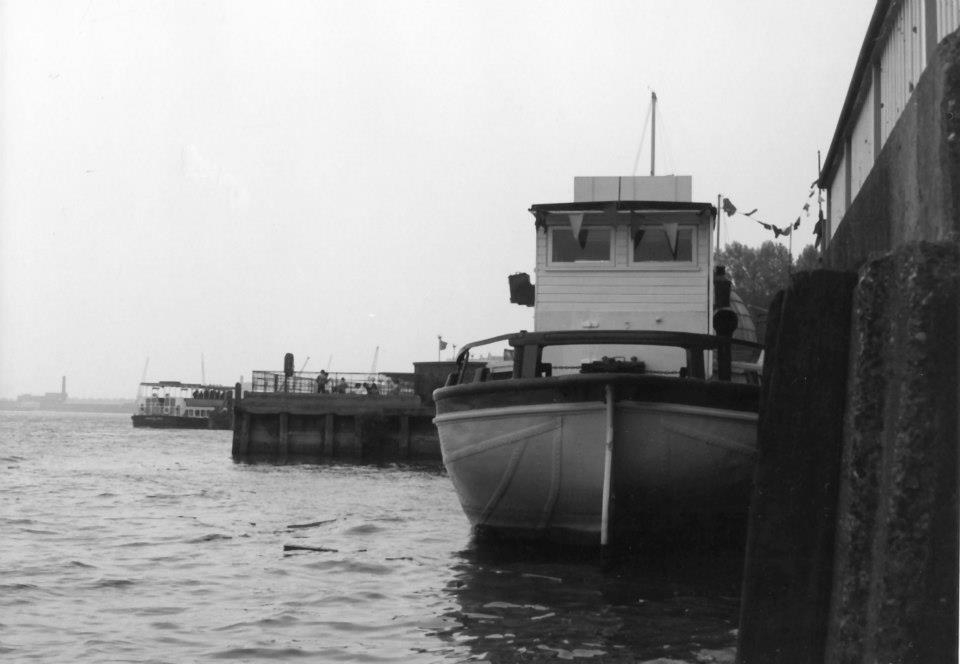
It’s now high tide at Greenwich and Bob has moored his boat up against the wooden fenders on the harbour wall, not far from where we were standing just a couple of years before. The wheelhouse has been restored and painted and the hull cleaned.
There is bunting attached to a pole on the shore. Why would you need bunting?
Because of this
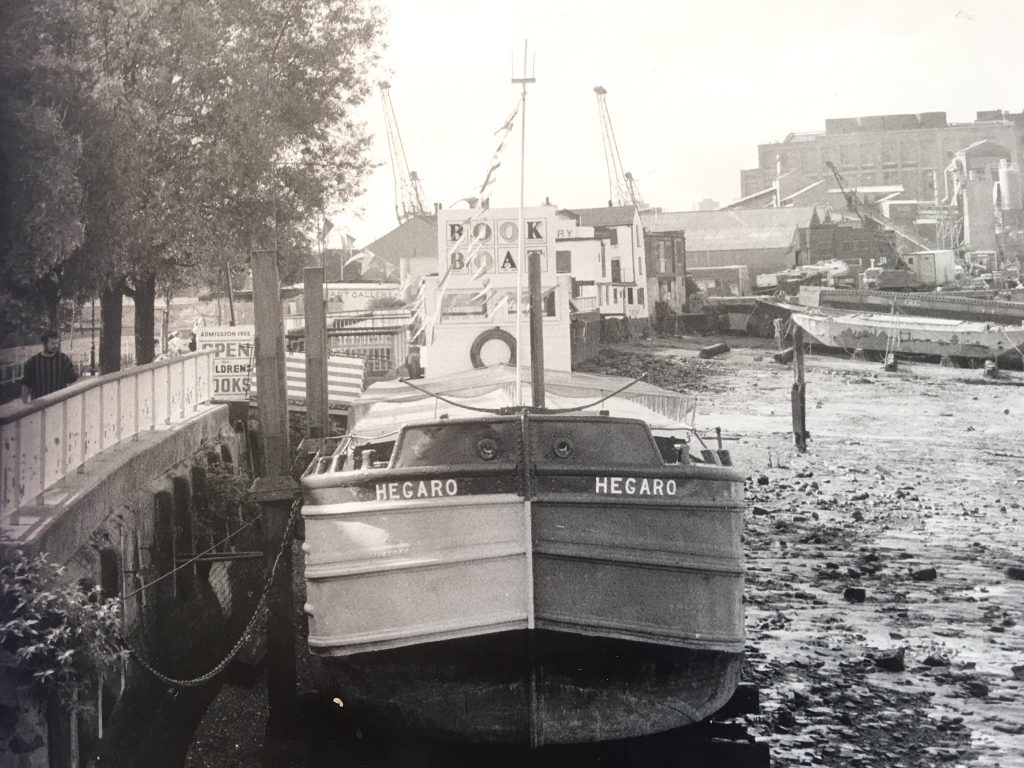
It’s a later picture, but Bob and Chris had built a boat that sells books. Still proudly sporting its original name maybe, but they’ve called it The Book Boat.
But it’s not floating. It is sitting on the river beach not far from where Bob was standing some two years previously. The tide is out.
A humber keel barge has a flat bottom. They were designed to be as fully laden as a river would allow. Ideal for sitting on this beach when the tide is out.
But Hegaro is firmly attached. Just look at the size of those stanchions and the chain moorings. If you look closely to the bottom right of the photograph you can see that the barge is not sitting on the strand – which has a pronounced slope – but on some equally sturdy timbers. And there is a clever system that allows the boat to move up and down on the tide, with two square hoops welded to the side that slide up and down the stanchions. Which is why they are so tall.
This boat doesn’t travel horizontally but vertically. Six point five metres, twenty-one feet, twice a day. And never leaves her spot.
In colour
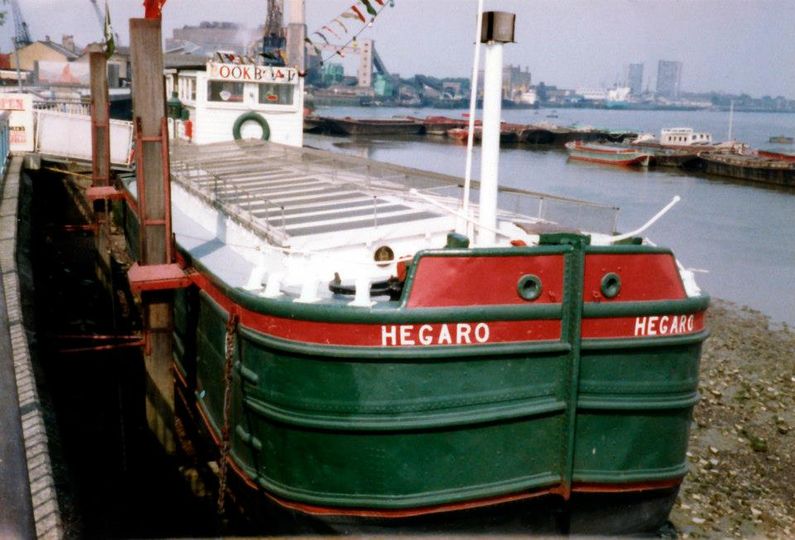
So here she is, Hegaro, in her original Cattell livery we believe. The tide still out but you can see more clearly how the stanchions work. The old tarpaulin cover of the abandoned hold has been replaced by a long range of glazed panels. And a protective net tensioned over them.
There’s not a lot of deck on a barge for walking round the edge and if you tripped you either fell in the river or onto tarpaulin covering the cargo. Replaced with a glass roof, you would need a safety net for sure.
TO BE CONTINUED
Colin Hicks, July 2026